
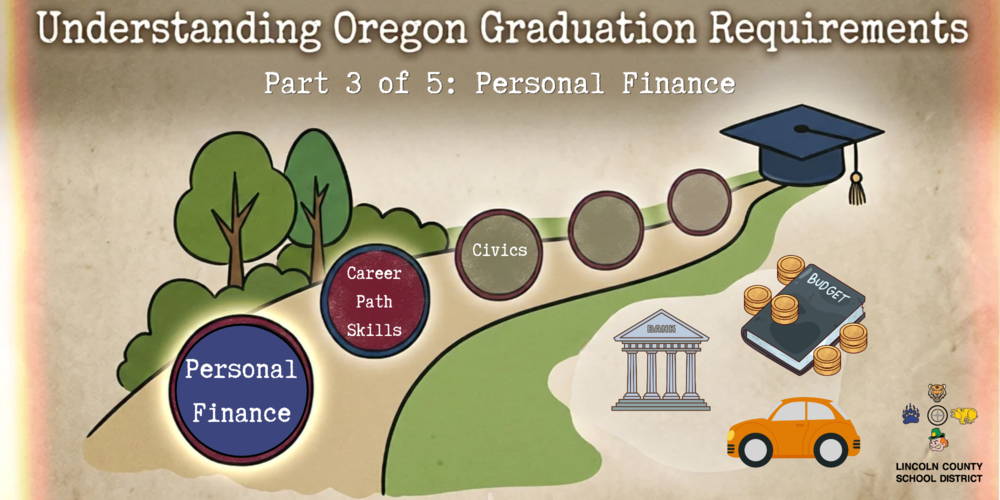
Beginning with students receiving an Oregon Diploma or Modified Diploma on or after Jan. 1, 2027, Oregon students must earn a half-credit in Personal Financial Education. Established by Senate Bill 3, the requirement is included within the existing 24 credits required for graduation and does not increase the total number of credits students must earn.
While the requirement is new, financial literacy education is not new to Lincoln County School District. LCSD has offered Financial Algebra for several years, and financial concepts also appear in mathematics, economics and career-focused courses. However, Personal Financial Education is a separate course with a different focus.
“In math, students might calculate interest. In personal finance, we explore what that interest means when choosing a credit card, taking out a loan or saving for retirement,” Waldport High School teachers Heather Greel and Conner Swertfeger said in a joint response. “Students compare options, evaluate risks and explain their decisions.”
Having a dedicated course allows students to connect financial concepts and apply them to situations they will encounter after high school. Topics include personal income and taxes; checking and savings accounts; budgeting; credit; loans and payments; car leasing and purchasing; mortgages; stocks; insurance; and retirement planning.
Students learn how to understand a paycheck, build a budget, use banking services, evaluate credit and loans, and consider the full costs associated with housing, transportation and other expenses.
LCSD uses resources from Next Gen Personal Finance as a foundation for the course. Teachers align lessons and assessments with Oregon’s standards while connecting the material to students’ lives through state and local examples.
“That includes using Oregon examples when discussing taxes and considering local costs when exploring financial decisions,” Greel and Swertfeger said. “Being able to calculate an answer is valuable, but students also need to understand the consequences of a financial choice.”
Because a half-credit course must cover a wide range of material, teachers prioritize decisions students are likely to face soon as well as choices that can have a lasting financial effect.
“Banking, budgeting, credit and understanding a paycheck are immediately relevant,” they said. “Saving and investing also deserve substantial time because starting early can make such a difference.”
Lessons may also change in response to student questions, common misconceptions or financial issues in current events. Rather than simply moving to the next topic, teachers can spend additional time helping students understand information that affects the decisions they make.
Greel and Swertfeger said students enter the course with widely different experiences involving money. Creating a classroom where students can ask questions without feeling judged about their families’ financial circumstances is an important part of the course.
“Our goal is for students to leave with practical skills and the confidence to evaluate information, ask questions and make informed decisions,” they said. “They will not remember every detail, but they should know what to look for and where to find reliable help.”
This story is part of a five-part LCSD series explaining Oregon’s new graduation requirements and diploma options.
Learn more about Oregon’s Personal Financial Education requirements: https://www.oregon.gov/ode/students-and-family/OregonDiploma/Pages/PFE.aspx